

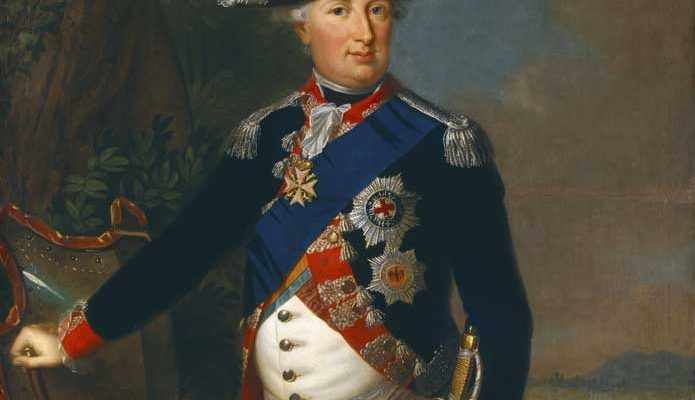
250 years ago, six German Principalities signed treaties with King George III
to supply troops to suppress the American Rebellion.
By Robert A. Selig
Juchheissa nach Amerika, Dir Deutschland gute Nacht!
Ihr Hessen, präsentiert’s Gewehr, Der Landgraf kommt zur Wacht.
Yay to America, good night to you Germany!
You Hessians, present the firelock, the Landgrave is
coming to inspect the guard.
This first of three stanzas of Ein schön und wahrhaftig Soldatenlied (A beautiful and true soldier’s song) was not possibly sung 19 October 1775 in Cassel during a parade before Landgraf Friedrich II of Hesse-Cassel by soldiers departing for America as the internet will tell you. But that day was not far off. The Leib-Infanterie-Regiment, the first Hessian unit that marched out of Cassel for Bremerlehe left on 15 February 1776 and arrived on Staten Island in New York on 14/15 September 1776. That was sixteen months after that fateful day of 19 April 1775, when near Lexington and Concord a few hundred Massachusetts militia had fired on British redcoats the shots that were “heard around the world”. Convinced that the rebellion would be put down quickly if a large enough number of well-trained troops could be hired and transported across the Atlantic Ocean on short notice, the British House of Commons, as it had done so many times before, looked to German principalities, particularly to Hesse-Cassel, to provide those troops. Hiring foreign soldiers to fight one’s wars was common practice in the 18th century. It was neither confined to Great Britain nor was the Landgraviate of Hesse-Cassel the only principality that for over more than a century leased its troops to whoever could pay for their services. Yet for numerous reasons, the “sale” of “barbarous Hessians” to the “Tyrant King George” who would use them to deprive his ungrateful subjects of their “rights as Englishmen” is the best-known example of this practice.
To read more subscribe now! Click here!