

Book Notes/Buchnotizen provides brief comments on recent books relating to German and German-American topics. Information as to price and ordering can be found at various Internet sites, or at the nearest bookstore.
By Don Heinrich Tolzmann
More has been written about the Pennsylvania Germans than the German element in any other state of the U.S. My German-Americana: A Bibliography (Heritage Books, 2007), for example, contained 141 entries for them, with the next closest state being Texas with 40 entries; other states had fewer. As the colonial center of the German element, and home of Germantown, the first permanent German settlement in America, it is not surprising that the Pennsylvania Germans have been the subject of so many publications. They have covered a wide variety of topics, and one of the most interesting is their early history before the American Revolution.
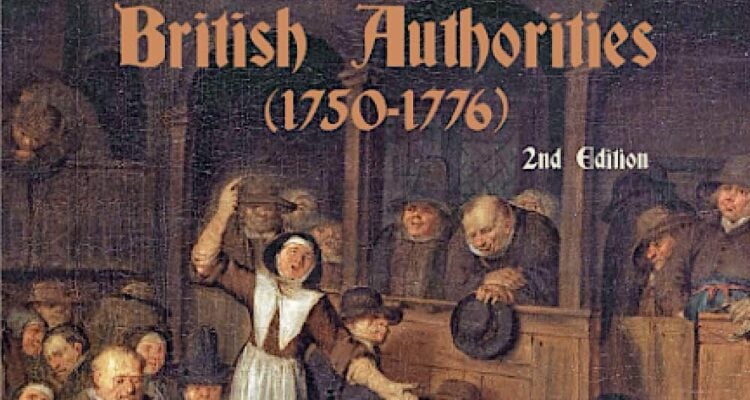
This is the focal point of Arthur D. Graeff’s The Relations between the Pennsylvania Germans and the British Authorities, 1750-1776. 2nd Edition (Distelfink Press, 2020). This is a revised edition of Graeff’s 1939 dissertation, which now contains copious footnotes, numerous illustrations, and a thorough index, provided by Lawrence Knorr who edited this history. Graeff (1899-1969) was a prolific historian of Pennsylvania German life. He wrote newspaper columns for the Reading Times, which appeared three times weekly from 1938 to 1969, and numbered more than 4,000 altogether. He served as president of the Pennsylvania German Folklife Society, which merged with the Pennsylvania German Society in 1966, and became the first president of the newly organized society.
Graeff notes that Pennsylvania had an estimated population of 225,000 by 1755, of which nearly one-half, or 110,000, was German. Early on, Germans were viewed favorably as “families of substance and industrious and sober people who brought with them their chests of apparels and other necessities…” Increased immigration led to the alarm of the English “who feared that the Germans would soon outnumber the English and force their language and customs on the entire province”. Benjamin Franklin, for example, was well known for comments such as: “Why should the Palatine Boors be suffered to swarm into our settlements and by herding together establish their language and manners to the exclusion of ours?”
Often called “the Dumb Dutch”, German settlers were anything but illiterate. They supported German newspapers, imported German books, and included persons educated at German universities, especially the clergymen. To allay fears the so-called Charity School Movement was launched by the London Society for the Propagation of the Gospel. However, its actual goal was to anglicize German immigrants and their children. Eventually, the movement was a failure, as such schools found little or no support. The English also had other concerns. With the French to the north and west of Pennsylvania, there was concern among the English as to the loyalty of the Germans. This was remarkable, as they apparently did not comprehend the depredations and destruction the French had brought to the German realm during the War of Spanish Succession (1701-14), which caused many Palatines and other Germans to immigrate. Allying themselves to the French would have been incomprehensible.
German loyalty was clearly shown during the French and Indian War when Pennsylvania Germans were found to be “the most dutiful and willing of service”. Graeff details their service and also describes their experience on the frontier. He does provide examples, but notes: “It is not the purpose here to chronicle all the horrible deeds of the Indians.” However, he does highlight the unit known as the Royal American Regiment, which consisted of Pennsylvania German, Swiss, and Scotch-Irish volunteers, and follows their various engagements. The loyalty and service of the Pennsylvania Germans during the war contributed to the disappearance of concerns about them among the English.
Graeff then follows the post-war movement of the Pennsylvania Germans into the western lands that had been claimed by the French. Here he comments that their role in the French and Indian War and on the frontier has been largely overlooked, and that general histories and secondary works have been silent concerning their history in the pre-Revolutionary War period. This is reminiscent of a comment by Henry Melchior Muhlenberg Richards in The Pennsylvania-German in the Revolutionary War, 1775-1783 (1908).
Regarding German contributions to the American Revolution, he wrote: “As we turn, with expected interest, to the pages of history, to learn somewhat of the character of these deeds, we are astonished to find them unrecorded. To such an extent has this been the case that unthinking and unreasoning persons have been led to believe that the German element of this country has been practically a nonentity in its development.” Similar comments have often been made by German-American historians.
Such views likely motivated Graeff to comment: “The Germans—wherever found—were always on the side of liberty.” He explains: “In the story of the Palatinate Germans’ experiences, transplanted on Pennsylvania soil, their love of liberty stands forth as the constant by which their political life can be measured. They were loyal to the authorities so long as loyalty and liberty were coordinates of the political system which claimed their allegiance … But when loyalty threatened the loss of liberty, the Germans made common cause with those who defied the authority of Great Britain. They sought and found greater liberty in independence. Having shared in the struggle for independence, they ceased to be foreigners.”
As editor Knorr correctly notes of his great uncle’s history: “It remains one of the best summaries of the contributions and attitudes of the Pennsylvania Germans at this formative time in American history. Today’s scholars will find a tale of immigration, cultural differences, and misunderstandings. They will also read about important contributions often overlooked or buried in other narratives of the period.”